What’s driving occupancy in the Western Cape right now, August 2026 onwards?
Cape Town heads into the second half of 2026 off the back of one of its strongest tourism runs in recent memory — and revenue managers across the Western Cape are watching closely to see how much of that momentum carries through the traditionally quieter winter months into spring. Here’s what’s actually shaping demand right now, and what it means for how you price and position your property.

1. Cape Town is still outperforming the rest of the country
Nationally, hotel occupancy has been cooling off from its late-2025 peak — sitting at 57.5% in March 2026, down from 60.7% in November 2025. But Cape Town continues to punch above the national average. Five-star properties in the city have consistently led all major South African metros, outperforming both KwaZulu-Natal and the national benchmark. That gap matters for Q3: even in the “low season,” Cape Town’s floor is higher than most of the country’s ceiling.
2. International air access keeps expanding — and that’s a leading indicator
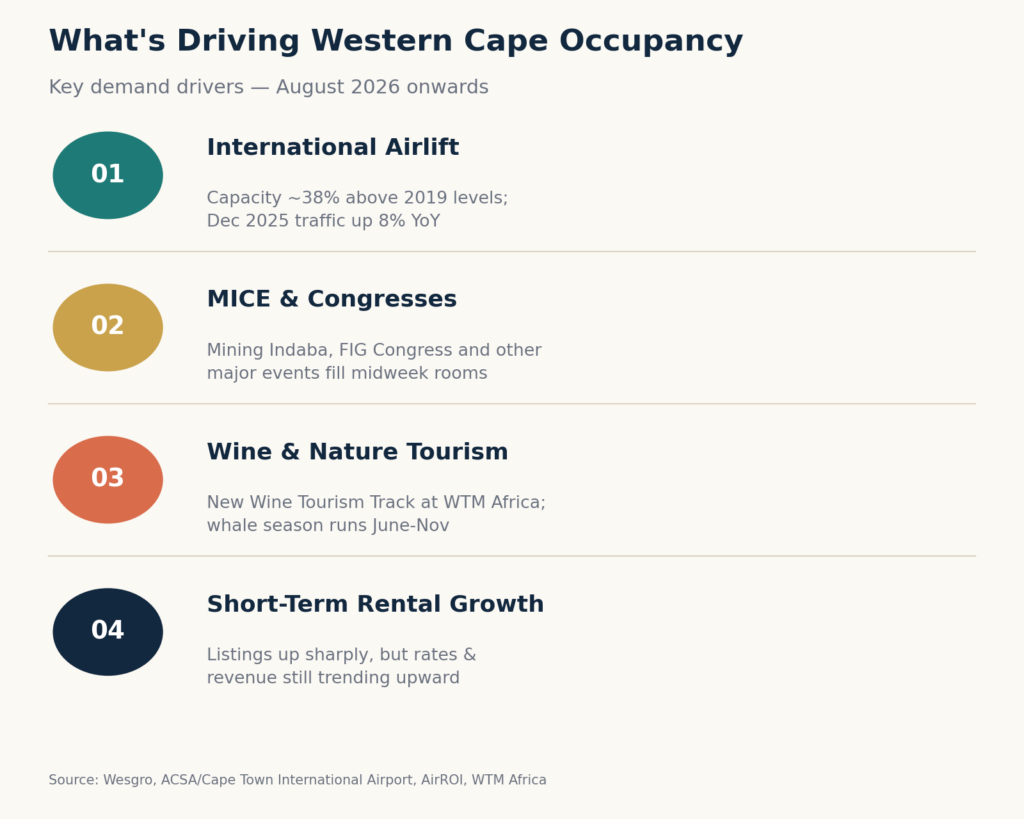
The single biggest structural driver behind sustained demand is airlift. Cape Town International Airport closed out 2025 with international passenger capacity roughly 38% above 2019 levels, and December 2025 alone saw 1.12 million two-way passengers — an 8% jump on the prior year. More seats in the market means more heads in beds, and airlines don’t add capacity speculatively — routes added for the 2025/26 summer season tend to stay in the schedule, which supports shoulder-season occupancy well into Q3.
3. The MICE calendar is doing heavy lifting for midweek occupancy
If leisure travel naturally dips in winter, business and conference travel is what fills the gap — and the Western Cape’s events calendar for the back half of 2026 is unusually stacked. The Cape Town International Convention Centre and surrounding venues are hosting a run of major congresses this year, from Mining Indaba to the International Federation of Surveyors Congress and the World Federation of Public Health Associations Congress, alongside sector-specific events in health, geoscience, renewable energy, and academia. Each of these brings delegate blocks that book well in advance and skew heavily midweek — exactly the inventory that’s hardest to fill organically in August and September.
4. Wine tourism and shoulder-season leisure demand are being actively cultivated
WTM Africa’s 2026 edition, held in April at the CTICC, introduced a dedicated Wine Tourism Track for the first time — a signal that the industry is deliberately trying to stretch demand beyond the December–February peak. Wine tourism, adventure sports, and whale-watching season (which opens in June and runs through the Q3 window) all give the Western Cape leisure hooks that don’t depend on beach weather, which is precisely the kind of demand that can offset winter rate softness.
5. Short-term rental supply is growing fast — and hotels are responding with experience, not just price
Airbnb listings in Cape Town have grown significantly over the past year, yet nightly rates and revenue have continued to trend upward alongside that supply growth — a sign that demand is currently outpacing new inventory rather than being diluted by it. For hotels, the competitive response has been to lean into service and experience differentiation rather than compete purely on rate, particularly at the upper end of the market where the ADR premium over short-term rentals remains wide.
What this means for Q3 positioning
Put together, the picture for August–September 2026 is less “quiet season” and more “different season.” Leisure demand softens from the summer highs, but airlift growth, a heavy conference calendar, and a deliberate push into wine and nature-based tourism are all working to smooth out what used to be a sharper winter trough. For revenue strategy, that means:
Protect midweek rate around known congress dates rather than discounting broadly — corporate and delegate demand is comparatively price-inelastic.
Package around wine, whale-watching and wellness for weekend leisure demand, where guests are choosing experience over beach weather.
Watch airlift schedules, not just booking pace — new or expanded routes are a reliable early signal of where demand is heading 60–90 days out.
The Western Cape isn’t just recovering anymore — it’s diversifying its demand base. That’s the real story behind the Q3 numbers.