
The Question This Update Answers
Many Cape Town hotel owners are asking the same question this winter:
“If the city is full of international tourists, why do my occupancy numbers still feel soft?”
The answer is that both observations are true.
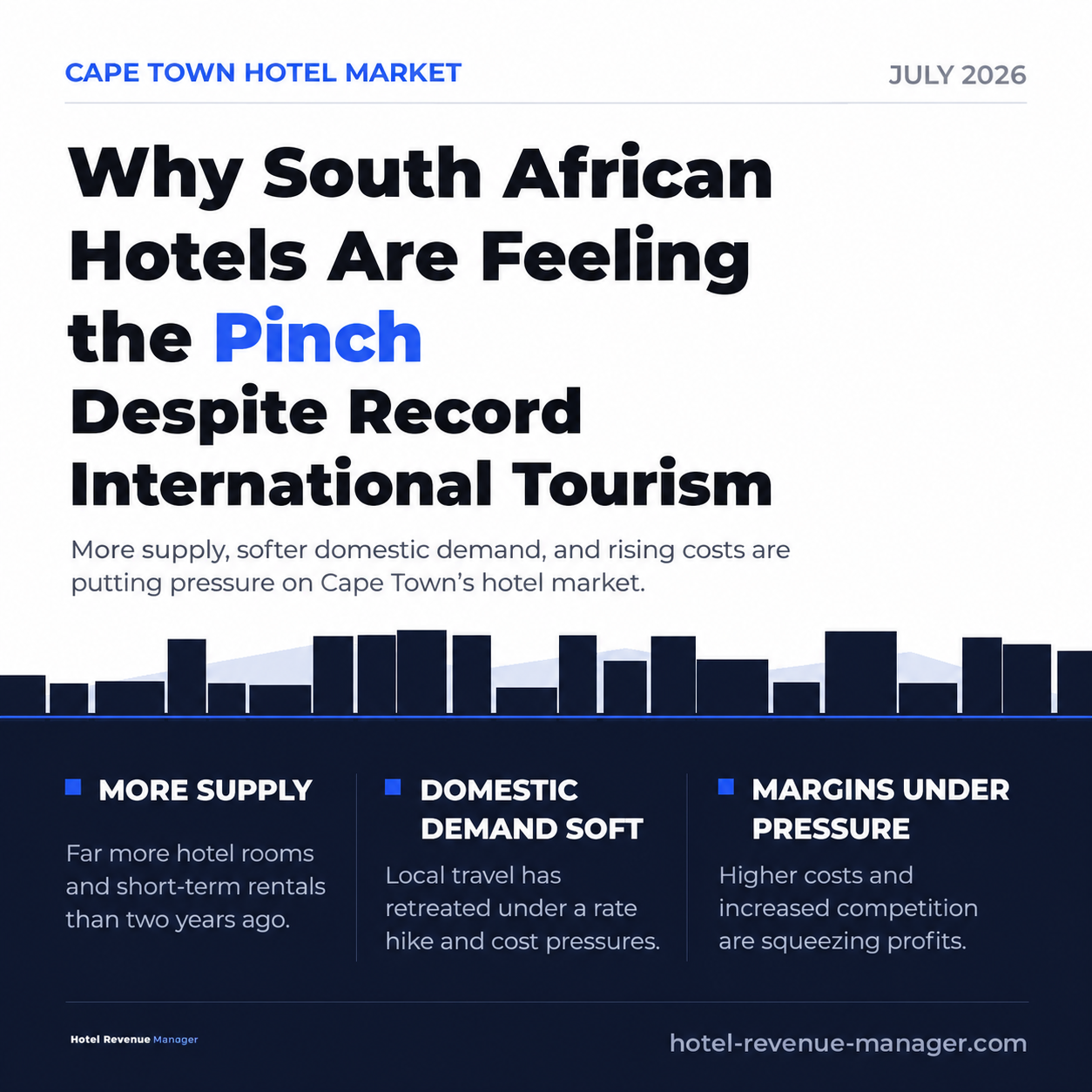
Cape Town is welcoming record numbers of international visitors, but those visitors are being spread across a much larger accommodation market than existed just two years ago. At the same time, domestic South African travel—the segment that traditionally supports occupancy during the winter low season—has weakened following higher interest rates and record fuel prices.
The result is a city that appears exceptionally busy, while many individual hotels experience softer occupancy than expected.

Key Findings
1. International demand is genuinely strong
Cape Town International Airport continues to record exceptional international traffic. Through 2025 and into 2026, the airport handled approximately 11.1 million two-way passengers, with international passenger volumes increasing by 7% year-on-year.
This confirms that the perception of a busier city is supported by the data—international tourism is performing strongly.
2. Accommodation supply has grown even faster
Demand has increased, but accommodation supply has expanded even more rapidly.
Over the past two years:
- More than 40 new hotel developments have entered or are entering the market.
- Around 30,000 active short-term rental listings are now competing for the same visitors.
As a result, growing visitor numbers are being distributed across significantly more rooms and beds. This naturally leads to lower occupancy for many operators, despite overall tourism growth.
3. Domestic travel weakened at the worst possible time
The domestic leisure market faced two significant economic shocks just as many winter holidays were being booked:
- On 28 May 2026, the South African Reserve Bank implemented its first interest rate increase in three years, raising the repo rate to 7.00%.
- On 3 June 2026, petrol reached a record R28.06 per litre, an increase of R7.31 since January, largely driven by higher global oil prices linked to the conflict in the Middle East.
For many South African travellers, these higher borrowing and transport costs reduced discretionary travel spending, directly affecting winter demand.
4. The market shows dilution rather than decline
Current performance indicators suggest that Cape Town is experiencing market dilution rather than a collapse in demand.
Revenue per Available Room (RevPAR) continued to grow year-on-year through April 2026, largely because average room rates remained strong, even while occupancy softened.
This combination is typical of a destination absorbing substantial new accommodation supply rather than losing visitors.
Furthermore, official 60-day booking forecasts for June 2026 indicate demand only marginally ahead of June 2025—hardly the severe downturn many operators feared and well above the deep declines experienced during previous market contractions.
5. AI search is reshaping hotel distribution
Another structural change is beginning to affect independent hotels.
Research from firms including Ahrefs and Sistrix indicates that Google’s AI Overviews can reduce click-through rates to the top organic search result by approximately 30% to 70%.
At the same time, AI-assisted trip planning is expected to become mainstream, with more than half of travellers projected to use AI tools during travel planning by the end of 2026.
Independent hotel websites—which typically rely much more heavily on organic search traffic than large online travel agencies (OTAs)—are therefore likely to experience greater pressure on direct website traffic and bookings.
6. Citywide averages hide very different realities
Perhaps the most important takeaway is that citywide statistics do not reflect individual hotel performance.
Even within the same market segment and during the same month, properties can experience vastly different results depending on factors such as:
- Distribution channel mix
- Reliance on direct bookings
- Exposure to organic search traffic
- Booking window changes
- Revenue management strategy
- Brand strength and repeat business
While some operators may experience only modest single-digit occupancy declines, others may see significantly steeper reductions despite operating in the same market.
Conclusion
Cape Town’s tourism market remains fundamentally healthy. International arrivals are reaching record levels, and visitor activity across the city is highly visible.
However, the market has changed.
A substantial increase in accommodation supply, softer domestic demand, higher travel costs, and evolving online search behaviour mean that record visitor numbers no longer translate automatically into high occupancy for every hotel.
Rather than signalling a downturn in tourism, current trading conditions reflect a more competitive market in which individual property performance increasingly depends on distribution strategy, pricing, digital visibility, and the ability to capture demand more effectively than competitors.