
Interestingly, no one said they were using AI to spin up entire ready-to-publish articles. But they are using AI tools to get out of writing ruts, analyze data, inform strategy, and automate marketing flows. The use cases were way more diverse than we imagined.
1. Pull insights from past campaigns for future strategy
Knowing which ad or blog post generated the most leads is easy. It’s harder to learn why they worked so you can double down on their success. Curt Woodward, Director of Content at ZoomInfo, devised a genius way to get Jasper, a generative AI copywriting tool, to help him figure it out.
Curt started by ranking a list of ZoomInfo’s content titles by a “power score” comprised of three weighted KPIs. Here’s a mockup of that list with fake data he uses for demonstration purposes.
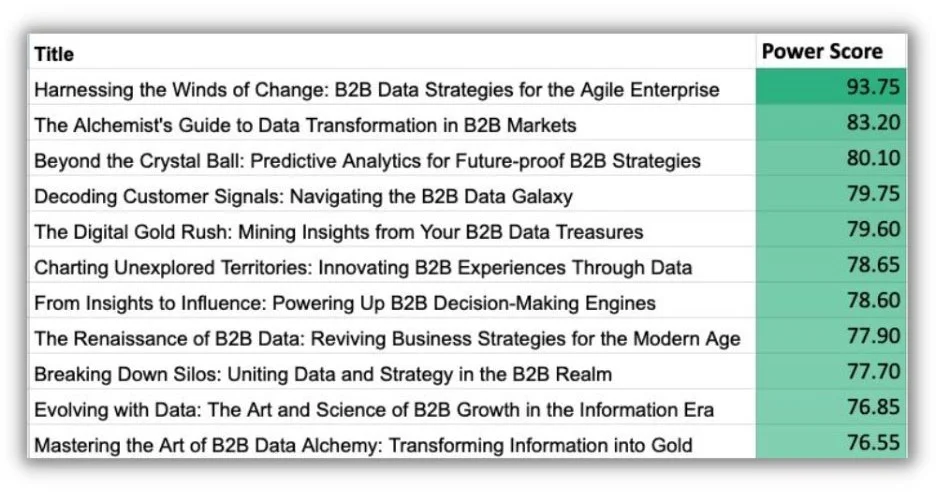
Next, he fed the list to Jasper, along with a prompt asking the AI to identify commonalities that would inform future content campaign choices.
His prompts looked like this:
“Act as a marketing analyst. I am going to give you a list of content titles with corresponding numbers, which represent a value score we use to determine top content. Higher scores are better.”
“Compare the content titles to find common themes, keywords, ideas, and approaches among the top-scoring titles. Suggest ways to replicate successful content packages.”
“Jasper, as a tool, often asks for more information about what you want the output of your prompt to look like,” Curt explained. “In this case, I gave it instructions about format, use of the memo, etc.”
Here’s the follow-up prompt Curt gave Jasper:
“I want to come away with a memo that summarizes our best themes, formats, and concepts for our future marketing content campaigns. Give us ideas and frameworks to use going forward.”
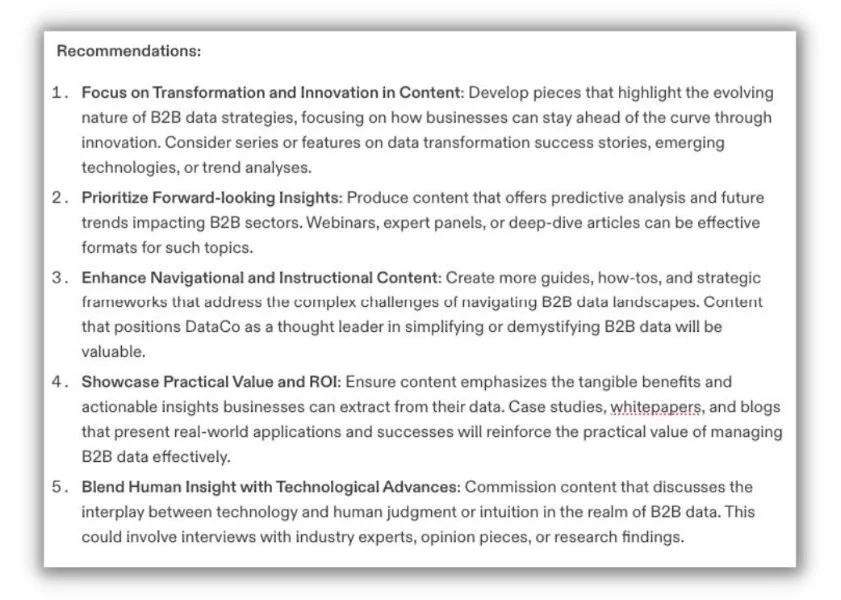
Based on the data and prompts Curt gave it, Jasper created a list of recommendations with detailed ideas for future content.
Curt qualified the fairly obvious results from this example by pointing out that it was fictitious data. He said you get a more insightful analysis when you feed it accurate information. Next up, he plans to get Jasper to proactively rank and sort the content assets by the power score, which will make the process even faster.
But for now, Curt suggests trying this tactic with other marketing copy. “You can easily adapt this for any measurable marketing asset. Ad and landing page copy comes to mind. Just rank them by whatever KPIs are important, and ask the AI to find themes you can use in future campaigns.”
2. Complete competitive analyses
Completing a competitive analysis is a core function for just about every marketer. The hard part is synthesizing competitive product features and brand positioning for multiple competitors.
Celia Quillian is an MBA and product marketing leader who’s also an influential voice in the artificial intelligence space through her channel @smartworkai on TikTok and Instagram. She uses ChatGPT Plus (the paid version) to quickly curate competitive intel.
“ChatGPT Plus’ web browsing feature is fabulous for competitive analysis,” she said. “In my prompts, I provide the links to competitor websites, asking that it only source from these sites for its competitive intel, and have it craft a table comparing the features of different market competitors.”
The free version of ChatGPT can’t surf the web. I tried a quick version of the request on perplexity AI using three HR software competitors.
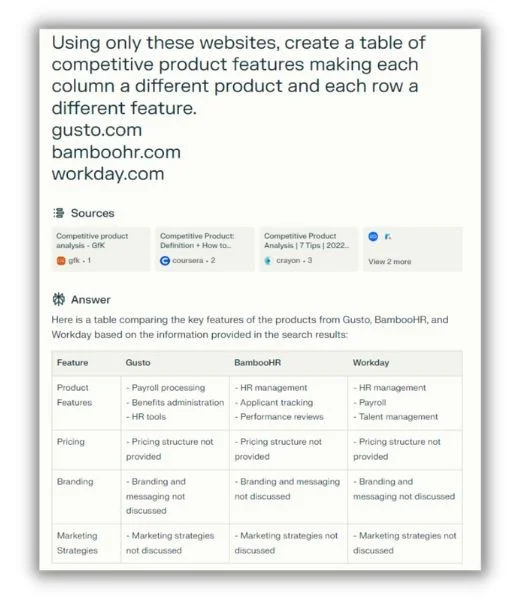
Obviously, this would need some additional prompts to make it useful. But Celia said AI is really good at that. “Generative AI models like GPT-4 have lengthy ‘context windows,’ meaning I can continually ask follow-up questions,” she said. “My combined prompts and answers only build on each other, helping me to learn, brainstorm, and find answers more efficiently.”
For context, Celia said ChatGPT Plus can “remember” the context of about 100 pages of written text.
3. Roleplay for customer sentiment
AI can’t replace humans, but it can pretend to be one. Celia said that’s a valuable feature of the technology. “ChatGPT is great at playing pretend, so when it comes to thinking of how I might solve a problem for a customer, I can ask ChatGPT to roleplay as my ideal customer persona.”
We gave this a try with the free version of ChatGPT. We fed the AI a description of a backpacking tent that focused on its weight, then entered this prompt:
“Pretend you’re the target customer for a company that sells outdoor camping gear. You’re very concerned about the durability and weight of the next backpacking tent you buy. How would you feel about this product description.”
Here’s what I got back.
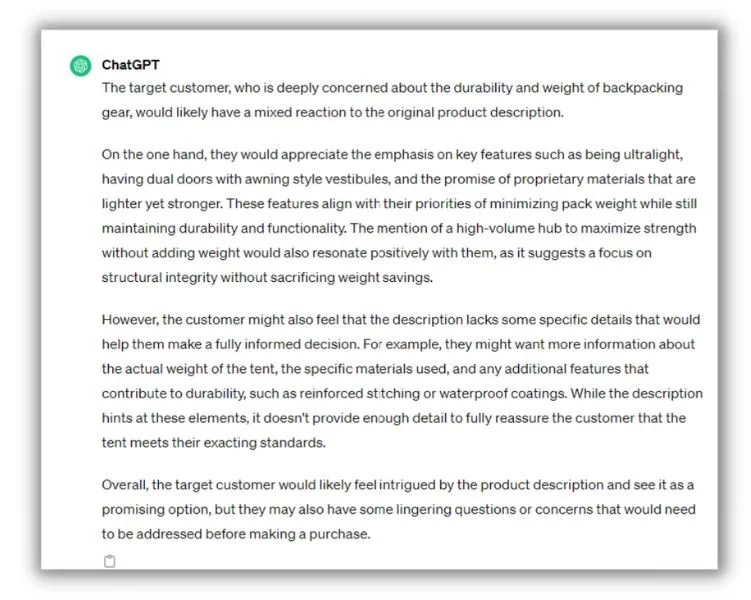
This was a simple example, but ChatGPT spotted the durability gap and suggested we add more specificity. Not bad.
“It’s never as good as talking with a real customer,” Celia added. “But it can make for a great stand-in when I’m in the early phases of research and ideation.”
4. Produce internal project management assets
One of the best applications of AI is to automate repetitive marketing tasks. That’s a common way Alaura Weaver, Content Marketing & Community Leader at Writer, uses it.
“I use Writer to spin up internal project management assets instantly—stuff like writing briefs, editing checklists, and creating content promotion plans,” she said. “That way, I don’t have to start from scratch with routine tasks.”
Alaura detailed how she creates briefs since that’s a common task for many marketing team leaders and those who work with freelancers.
“I built a custom ‘brief generator’ app in our no-code Writer App Studio,” she explained. “All I have to do is give a working title, indicate what audience the piece is for, and paste or upload source material (like an executive LinkedIn post, research article, or dev documentation). The app generates content briefs that align with our business goals and content strategy (which I baked into the prompt that powers the generator).”
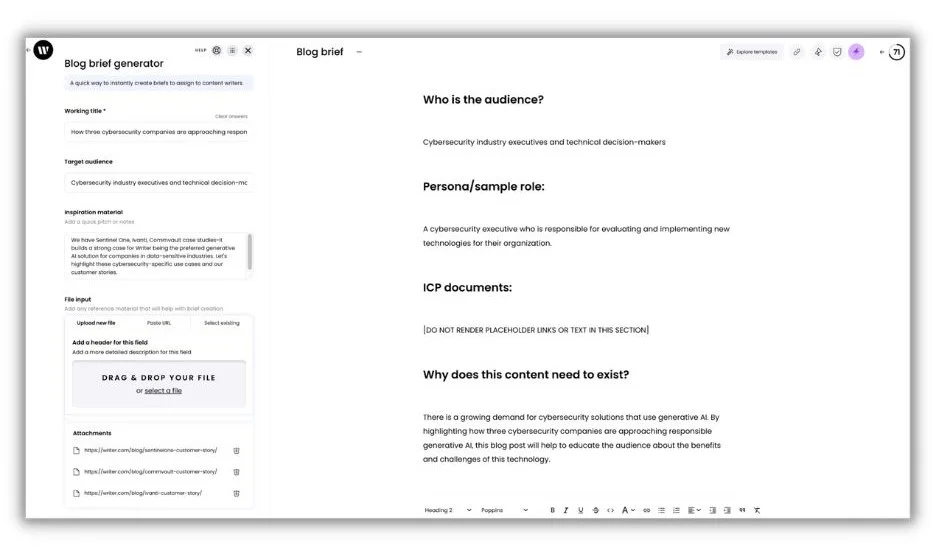
Alaura said that using AI this way speeds up the entire editorial process, freeing up bandwidth for high-level tasks.
“The output follows a consistent format, so I can easily plug it into docs without much editing,” she said. “It means that my writers have what they need to get started on assignments a lot faster, and it means I have more time to focus on fun, creative, strategic work like producing our Humans of AI podcast.”
5. Find thinking models for thought leadership content
The best thought leadership content has a unique, personal, and interesting point of view. It’s not the typical wheelhouse for robotic writing.
But Anjana Vasan, a Senior Copywriter and Content Strategist at Block Club, found an unexpected way to improve thought leadership content with AI. She asks ChatGPT for thinking models or academic concepts related to her topic.
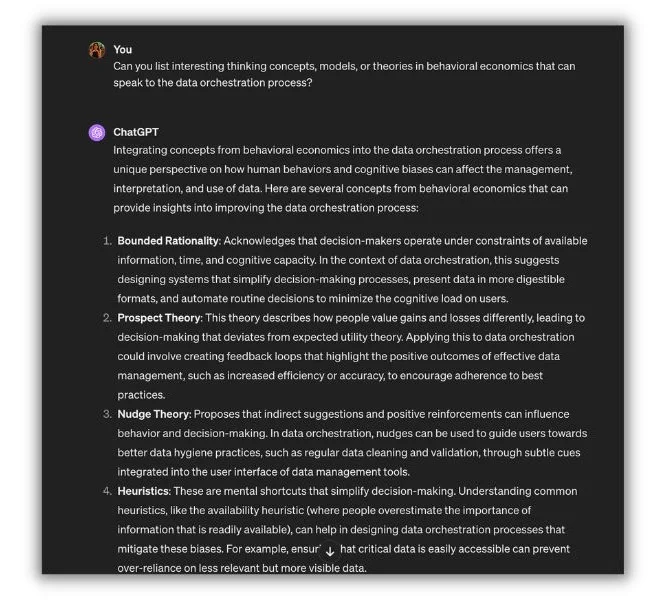
“Using AI this way, I can develop a unique point of view or think of an interesting metaphor and connect the dots to the topic or the person I’m writing for,” Anjana said. “All while still keeping their experience and expertise in mind.”
The great thing about this tactic is that it works with just about any AI writing assistant or even generative search platforms like Perplexity AI.
6. Analyze data for SEO audits
Anjana showed us another way AI can help analyze large blocks of data—this time for SEO audits.
Here, she asked ChatGPT to review a spreadsheet of content links.
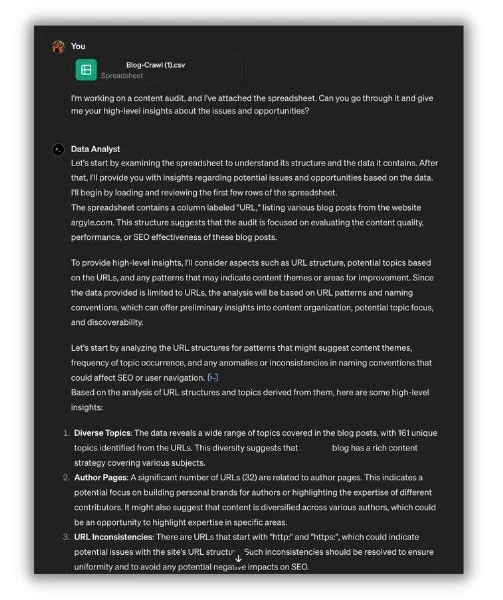
“Usually, I dig in further with additional questions or prompts to draw the insights I’m looking for,” she said. “Or I ask ChatGPT to organize the data so I don’t spend my time on administrative tasks.”
Here are some of the follow-up prompts Anjana uses:
- “Based on the available data, can you identify the top 10 pieces of content?”
- “Have you noticed any themes or overarching topic categories in all the content?”
- “Can you edit the spreadsheet to include only the URL, date of publication, title, meta description, and word count and remove the other columns?”
She warned that this tactic only works with the right information and that any AI output should be double-checked.
“The results are only as good as the quality of your data, so ensure you include the right types of information in your file,” she said “And remember to validate the information since you may not always get the right insights if you rely completely on ChatGPT.”
7. Link ideas while you write automatically
If you have folders full of half-complete ideas and clever copy that are hard to find when you need them, Anna Burgess Yang feels your pain. “I publish a lot of work online and have thousands of notes from articles I’ve read, podcasts I’ve listened to, and even my own writing. In the past, I’ve relied on tags or categorization in note-taking apps to connect topics or ideas.”
Anna is a prolific freelance content marketer and a self-described workflow automation geek. She uses an AI tool called Reflect to surface related notes based on the text she’s writing. So, mid-draft, Anna will see categorized suggestions from her network of documents.
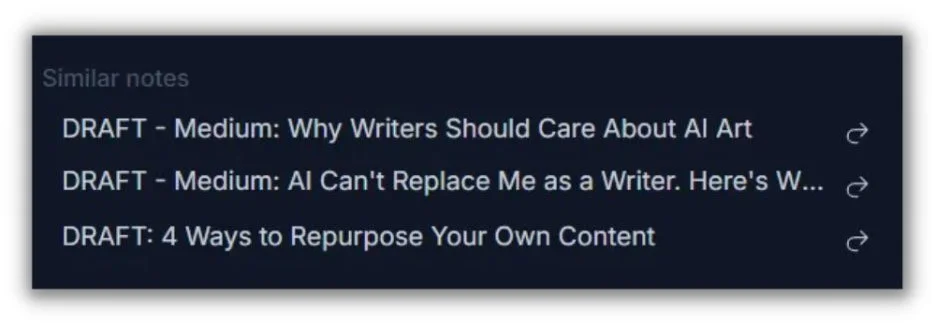
Our human brains are wonderful, but they’re not always great at quickly recalling a specific point buried amongst thousands of others. AI is ideally suited for the job. “This has become an invaluable part of my note-taking since AI can pull ideas together that I may have overlooked or not considered,” Anna said.
We share some more of this info next – Stay tuned!
Copyright: www.wordstream.com