
A couple of years ago, most of us marketers hadn’t the foggiest idea of how to use AI for marketing. Suddenly, we’re writing LinkedIn posts about the best prompts to whisper into ChatGPT’s ear.
But our rapid adoption of AI may be getting ahead of important ethical, legal, and operational questions—which will leave marketers exposed to risks we never had to think about before (i.e. can we be sued for telling AI to “write like Stephen King?”).
There’s a metric ton of AI dust in the marketing atmosphere that won’t settle for years. No matter how hard you squint you won’t make out every potential pitfall of using large language models and machine learning to create content and manage ads.
So our goal in this article is to view seven of the most prominent risks of using AI for marketing from a very high ground. We’ve rounded up advice from experts to help mitigate these risks. And we’ve added plenty of resources so you can dig deeper into the questions that concern you most.
Today we will share 3 of the risks you can face using AI for marketing.
Risk #1: Machine learning bias
Sometimes machine learning algorithms give results that are unfairly in favor or against someone or something. It’s called machine learning bias, or AI bias, and it’s a pervasive problem with even the most advanced deep neural networks.
It’s a data problem
It’s not that AI networks are inherently bigoted. It’s a problem with the data that’s fed into them.
Machine learning algorithms work by identifying patterns to calculate the probability of an outcome, like whether or not a particular group of shoppers will like your product.
But what if the data the AI trains on is skewed towards a particular race, gender, or age group? The AI will come to the conclusion that those people are a better match and skew ad creative or placement accordingly.
Here’s an example. Researchers recently tested for gender bias in Facebook’s ad targeting systems. The investigators placed an ad to recruit delivery drivers for Pizza Hut, and a similar ad with the same qualifications for Instacart.
The existing pool of Pizza Hut drivers skews male, so Facebook showed those ads disproportionately to men. Instacart has more women drivers, so ads for their job were placed in front of more women. But there’s no inherent reason that women wouldn’t want to know about the Pizza Hut jobs, so that’s a big misstep in ad targeting.
AI bias is common
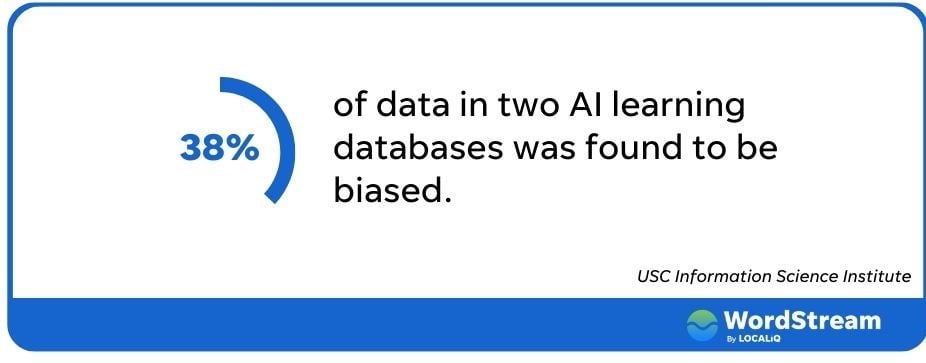
The problem extends way beyond Facebook. Researchers from USC looked at two large AI databases and found that over 38% of the data in them was biased. ChatGPT’s documentation even warns that their algorithm may associate “negative stereotypes with black women.”
Machine learning bias presents several implications for marketers; the least of which is poor ad performance. If you’re hoping to reach the most potential customers possible, an ad targeting platform that excludes large chunks of the population is less than ideal.
Of course there are bigger ramifications if our ads unfairly target, or exclude, certain groups. If your real estate ad discriminates against protected minorities, you could land on the wrong end of the Fair Housing Act and the Federal Trade Commision. Not to mention completely missing the inclusive marketing boat.
How to avoid AI bias
So what do we do when our AI tools run amok? There are a couple of steps you can take to make sure your ads treat everyone equitably.
First and foremost, make sure a someone reviews your content, writes Alaura Weaver, the senior manager of content and community at Writer. “While AI technology has advanced significantly, it lacks the critical thinking and decision-making abilities that humans have,” she explains. “By having human editors review and fact-check AI-written content, they can ensure that it’s free from bias and follows ethical standards.”
Human oversight will reduce the risk of negative outcomes in paid ad campaigns, too.
“Currently, and perhaps indefinitely, it is not advisable to let AI completely take over campaigns or any form of marketing,” says Brett McHale, the Founder of Empiric Marketing. “AI performs optimally when it receives accurate inputs from organic intelligence that has already accumulated vast amounts of data and experiences.”
Risk #2: Factual fallacies
Google recently cost its parent company $100b in valuation when its new AI chatbot, Bard, gave an incorrect answer in a promotional tweet.
Google’s goof highlights one of the biggest limitations of AI, and one of the biggest risks for marketers using it: AI doesn’t always tell the truth.
AI hallucinates
Ethan Mollic, a professor at the Wharton School of Business, recently described AI-powered systems like ChatGPT as an “omniscient, eager-to-please intern who sometimes lies.”
Of course, AI isn’t sentient, despite what some may claim. It doesn’t intend to deceive us. It can, however, suffer from “hallucinations” that lead it to just make stuff up.
AI is a prediction machine. It looks to fill in the next word or phrase that’ll answer your query. But it’s not self-aware; AI doesn’t have gut-check logic to know if what it’s stringing together makes sense.
Unlike bias, this doesn’t seem to be a data problem. Even when the network has all the right info, it can still tell us the wrong thing.
Consider this example where a user asked ChatGPT “how many times did Argentina win the FIFA world cup?” It said once and referenced the team’s 1978 victory. The tweeter then asked which team won in 1986.
The chatbot admitted it was Argentina with no explanation for its former gaffe.
The troubling part is that AI’s erroneous answers are often written so confidently, they blend into the text around them, making them seem completely plausible. They can also be comprehensive, as detailed in a lawsuit filed against Open.ai, where ChatGPT allegedly concocted an entire story of embezzlement that was then shared by a journalist.
How to avoid AI’s hallucinations
While AI can lead you astray with even single-word answers, it’s more likely to go off the rails when writing longer texts.
“From a single prompt, AI can generate a blog or an eBook. Yes, that’s amazing – but there’s a catch,” Weaver warns. “The more it generates, the more editing and fact-checking you’ll have to do.”
To reduce the chances that your AI tool starts spinning hallucinatory narratives, Weaver says it’s best to create an outline and have the bot tackle it one section at a time. And then, of course, have a person review the facts and stats it adds.
Risk #3: Misapplication of AI tools
Every morning we wake up to a new crop of AI tools that seemingly sprouted overnight like mushrooms after a rainstorm.
But not every platform is built for all marketing functions, and some marketing challenges can’t (yet) be solved by AI.
AI tools have limitations
ChatGPT is a great example. The belle of the AI ball is fun to play with (like writing how to remove a peanut butter sandwich from a VCR in the style of the King James Bible). And it can churn out some surprisingly well-written short form answers that bust up writer’s block. But don’t ask it to help you do keyword research.
ChatGPT fails because of its relatively old data set which only includes information pre-2022. Ask it to offer keywords for “AI marketing” and its answers won’t jive with what you find in other tools like Thinword or Contextminds.
Likewise, both Google and Facebook have new AI-powered tools to help marketers create ads, optimize ad spend, and personalize the ad experience. A chatbot can’t solve those challenges.
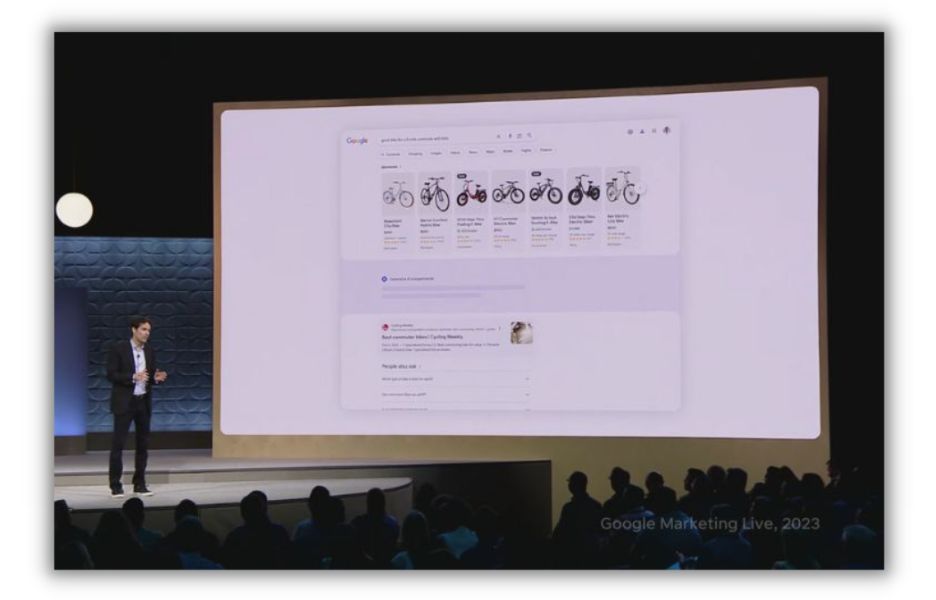
Google announced a slew of AI upgrades to its search and ads management products at the 2023 Google Marketing Live event.
You can overuse AI
If you give an AI tool a singular task, it can over index on just one goal. Nick Abbene, a marketing automation expert, sees this often with companies focused on improving their SEO.
“The biggest problem I see is using SEO tools blindly, over-optimizing for search engines, and disregarding customer search intent,” Abbene says. “SEO tools are great for signaling to search engines quality content. But ultimately, Google wants to match the searcher’s ask.”
How to avoid misapplication of AI tools
A wrench isn’t the best option for pounding nails. Likewise, an AI writing assistant may not be good for creating web pages. Before you go all in on any one AI option, Abbene says to get feedback from the tool’s builder and other users.
“In order to avoid mis selection of AI tools, understand if other marketers are using the tool for your use case,” he says. “Feel free to request a product demo, or trial it alongside some other tools that offer the same functionality.”
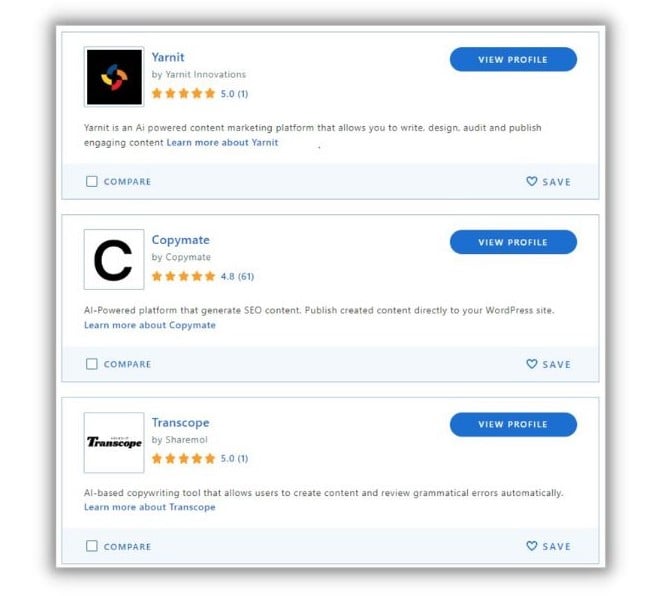
Websites like Capterra let you quickly compare multiple AI platforms.
And once you find the right AI tool stack, use it to aid the process, not take it over. “Don’t be afraid to use AI tools to augment your workflow, but use them just for that,” Abbene says. “Begin each piece of content from first principles, with quality keyword research and understanding search intent.”
We share some more of this info next – Stay tuned!
Copyright: www.wordstream.com