
Revenue Management White Paper
The steady decline of tourism demand into Cape Town versus a steady incline of demand in supply in Cape Town since 2017 and proposed replacement strategy
29 September 2019
Purpose
The purpose of this paper is to articulate researched observations in the market place to date, as well as to outline possible alternative outcomes for independent operators, owners and managers of accommodation provision in the Cape Town metro and surrounds
Background
Following a slow and steady supply of incoming leisure tourists from abroad in years following 2010 world cup soccer. Most of accommodation suppliers enjoyed a small but stable increase annually peaking with record number reported during the 2016-2017 financial year. However, we have seen and steady and noted decline over the past 3 years following the 16-17-year peak.
Analysis
With the president’s call to double visitor numbers to around 21 million by 2030 we have to analyse where we are at present through the following data coupled with front line experience and observation.
Stats SA reported a 6% international tourist arrival decline off the back of a 2% decline in 2018. To reach 21 million by 2030 we will need 6% per annum compounded increase. Over the past 9 years we have see 6% only twice in 2014 and 2016. In 2018 we had 10.5 million tourists of which 2.7 we from overseas and the remainder regional (from the rest of Africa) Source: BDO South Africa.
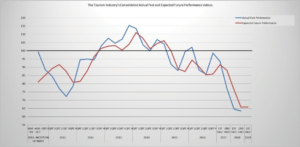
We at www.hotel-revenue-manager.com have noted the steady decline which is affirmed by below table showing decline between 2017 and 2018, and 2019 in the same downward trend and expected to end below 2018.
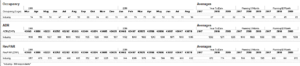
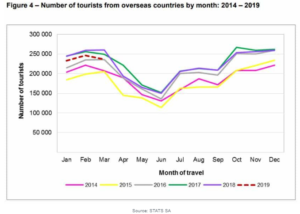
The supply in Cape Town metro went from 8000 room nights available per day in 2011 to nearly double that presently with the addition of homestays, apartment rentals, online travel agents entering the market and new hotel developments. (www.businesstech.co.za reported mid 2018 of a staggering 35 new developments in the CBD and www.2oceansvibe.com report in June 2019 of R20 billion with of development into Cape Town.) The room night supply will easily reach 25 000 by the end of 2020 if one factor in all the new apartments in development and these being rented out as short stays. To add to this supply we noted reports of an ‘’all time high’’ empty apartments as reported by www.thesouthafrican.com in May 2019 quoting 7-10% of apartments currently empty vs the 3% benchmark. If one adds the new developments, this number will increase even more.
Local government in all their stellar efforts are still bound by national regulations in certain aspects such as water and policing which both had a profound effect on tourism numbers into Cape Town itself. These coupled with negative feedback on: unabridged birth certificates yo-yo, changes in Visa regulations, mugging and death of tourists, the drought in 2018, xenophobic attacks, service delivery protests, theft at hotels of which many made international headlines. We have to accept that government policies on tourism won’t guarantee its implementation nor can affect or control it on the ground which will directly affect the tourism landscape
Fast track to current: As if these weren’t damaging enough, the latest Thomas Cook debacle seem to be a (final) nail in the coffin? To elaborate on Thomas Cook a bit more: there was 3 weekly flights during Dec to Mar annually into CPT from Gatwick, each flight carrying 322 passengers which is 966 a week over 17 weeks (16 422 passengers) is no longer travelling. Less competition = higher prices where a Gatwick CPT flight would be around R10 500, we see BA (British airways) now charging R15 500 for the same flights which affect the cost value proposition for anyone considering the journey.
The international tourist market have found Tanzania and Kenya much more appealing and their numbers are at record highs reporting a 8% increase as at Nov 2018 by a www.tourismupdate.co.za article. Therefor we lost a significant amount of the African market. Couple with increased supply will leave only the hotels with a superior product and location in the running for the little of the international market left. These properties would be in and around key features of the city and offering a fair and sometimes lower than average rate to capture the market in an attempt to heal their ailing market segment.
Our company serves 16 000 room nights a month in CPT and we have received reports late Aug 2019 of unusual cancellation activity from tour operators, travel agents and corporate bodies in the sector. The cancellations take effect in oct 2019 to march 2020 and usually carry a 30-day cancellation policy hence the September time report. Our clients combine lost close to R3 million rand for Oct only, Nov + 30% and Dec to March still coming in. The booking pace for Oct have slow down to such an extend that we have occupancy reports of about 40% with Nov looking medium and Dec looking very low (except period 24-31 Dec). Fedhasa in fact are conducting a survey to establish the impact value which indicate the losses are widespread.
Most hoteliers, owners and operators are most probably still unaware of this trend which is harmless of they don’t have this market segment. However, its potentially damaging as hotels with lost revenue will seek alternate channel to dump stock and a most likely reduced rate. OTA’s are their first choice due to its real time feedback, but EVERYONE trades here. The effect will be more stock, at reduced rates will spread the demand so thin that one single market affected the whole eco system. We already see the trend and noted a plethora of promotions over traditionally higher demand periods.
Proposal
Most operators and hoteliers manage by market segment, STO (group and individual), leisure, corporate, Group and convention, government and so forth. The challenge is that the way these market book (by channel) have distorted its origin and we can honestly not manage and market by these number any longer. Example, if a travel agent uses booking.com to book their corporate client into hotel would be marketed to in the future exactly how?
We propose to manage by channel, all rooms sold everyday should be allocate to a channel such as: OTA, IBE (own web), GDS, social media, etc. These channels have their own characteristics, features to market on and opportunities to grow business.
A definitive shift to online from packaged tour operator was the main factor in Thomas Cook’s demise as reported on www.TheGuardian.com on 23 September 2019. This shift has also seen its way into hotel beds over the past 10 years and OTA are the largest suppliers of any lodging operation at present. Some properties receive up to 90% of their business from OTA’s normally Booking.com first, followed by Expedia, then others such as GDS own website etc. Hoteliers however have kept themselves busy with growing direct revenue through own website, whilst it is possible, its time consuming and expensive. Taking a step back, should hoteliers not acknowledge the shift to online business instead of chasing after traditional market segments? In a financial review only god be satisfied that the online channels are up on last year and leave it there but focus on other segments and why they are down? Should we not fish where the fish are? Or some will argue it dangerous to fish from one basket, but did they notice the different species of fish in the basket each with their own characteristic and trends?
Each channel can supply a hotel with: source market, device used, reason for travel, device (mobile/tablet/desktop) originating city, lead time of booking, average length of stay, most popular booking dates and arrivals dates, competitor rates, a host of reporting from sales per day per period per room per person to name but a few. This information is hardly discussed or taken into consideration in review meetings (possibly due to the pint made earlier.)
For cape town specifically we see at least 30% of all booking are local bookings meaning South Africans travelling from other cities, this market has increased but I doubt it was seen as an opportunity while everyone runs after international operators. We see an increase in bookings from US, Angola, Brazil, Saudi Arabia, Russia, India and the UK. (wait the UK? Yes, using OTA to stay and other airlines such as Emirates to fly). We see an increase in mobiles used for bookings and a much shorter lead time. We see customers expecting an experience rather than a star rating quality expectation. Buyers want to book with little commitment, have a wide variety, little restrictions, based on other buyer reviews and think they saved by getting a deal or promotion.
To close we propose for hoteliers to take note of the macro environmental changes but to look closer at what they already know and get more from where the most is coming now. Manage by channel and not by segment and you will understand your business and its clients better.
Jaco Jacobs
www.hotel-revenue-manager.com