
After decades of science fiction novels, films, and serialized Twilight Zone derivatives, the rapid onset and development of artificial intelligence has finally come to fruition.
No matter where you go on the internet these days, you will quickly become bombarded by the reality that not only has AI already become a valuable tool for mankind, but its long-term implications and rapid trajectory leave a multitude of concerns on our horizon.

There are technophiles who champion the advancement of artificial intelligence and its alarming ascension towards singularity, while understandably, many others are more than terrified of its risks.
Regardless of where you stand on the topic, one thing is clear for now: AI tools like ChatGPT are available, being heavily used, and will continue to evolve over future updates.
With these points in mind, it is clear that AI is going to have a significant impact on digital marketing (as well as almost every other industry and profession) in the coming months and years.
Here, I will highlight six predictions for ChatGPT, AI, and the future of PPC marketing:
- Increased competition (and higher costs)
- Improved targeting
- Enhanced ad copy
- More efficient ad campaigns
- Greater reliance on machine learning
- Continued innovation
Let’s get started.
1. Increased competition (and higher costs)
Due to AI tools like ChatGPT’s potential to provide advertisers with more powerful tools for targeting and optimizing their PPC campaigns, increased competition for an already saturated ad space may ensue. If advertisers who are leveraging ChatGPT are able to achieve better results and generate more revenue from their campaigns, then it may lead to higher prices for keywords and make it even more difficult for smaller advertisers to compete.
ChatGPT could be particularly beneficial for larger advertisers who have the resources to invest in machine learning algorithms and other advanced technologies. These advertisers may be able to use ChatGPT to gain a competitive advantage and outbid smaller advertisers for ad space. It is a possibility that increased usage of ChatGPT and other AI tools may improve blind spots that the account managers, agencies, and practitioners who are working for larger businesses otherwise would have missed.
It’s important to note that this prediction is not certain, and there are many factors that could influence the competitiveness of the paid media space for years to come. One thing is fairly certain though, and that is search advertising is not getting any cheaper.
Another issue that has been discussed is the reduction in the usage of Google Search because of ChatGPT.
The AI tool is very capable of answering nearly any question that you would search for on Google in addition to curating lists of recommendations for you for travel or entertainment. (The only caveat is that ChatGPT, in particular, is unable to source information beyond 2021 at this time.)
Google recently announced its own AI search experience, Google Search Generative Experience (SGE), which integrates AI into the SERP. This experience pushes organic search results even further down the page and may impact non-paid search traffic and click-through rates, leading to increased competition to show in Google Ads above SGE results.
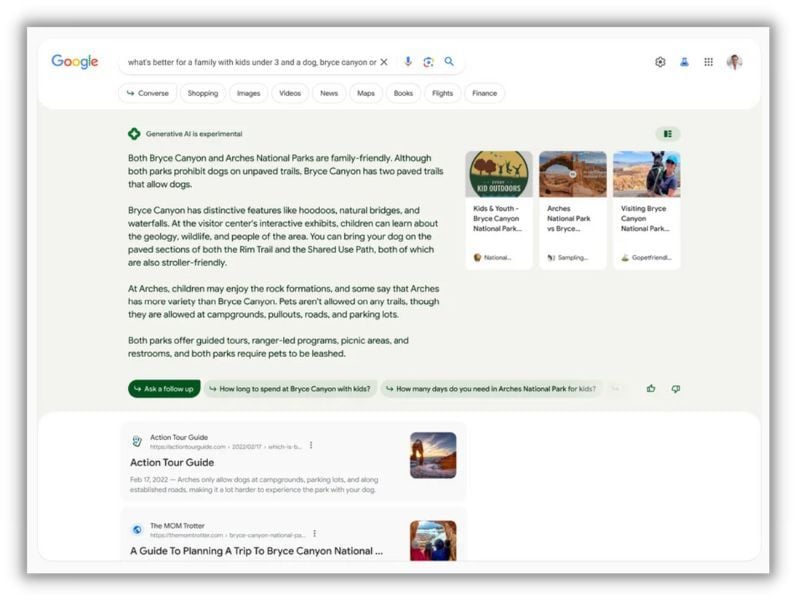
The bottom line: Even with ChatGPT and Google SGE, I don’t believe that AI tools are going to be the end of search ads or search as a whole, but I do believe it is part of an evolution or transition to a more efficient model.
2. Improved targeting
ChatGPT (and AI in general) has the ability to analyze large amounts of data and generate insights about audience behavior. We already see this to a degree with smart bidding strategies within Google Ads.
Given that the target keywords and ad copy you have created are aligned, Google’s automated bidding can “learn” over time how to produce more of the desired results that you want, such as conversions, clicks, and more.
AI tools, however, have the capability of analyzing data through text, CSV, or JSON files. This means that it can analyze user behavior on websites and other digital channels to identify patterns and trends. It can track which pages users visit, how long they stay on each page, and which actions they take (such as clicking on links or filling out forms).
ChatGPT can also be a valuable tool for keyword research–curating lists and structures for ad groups for you to target. (Although we don’t recommend using it as your primary keyword research tool.)
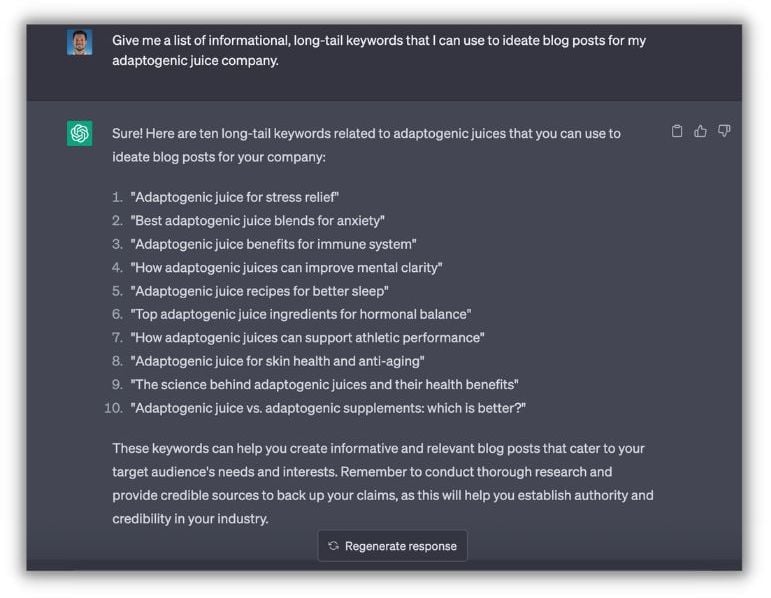
With this information, ChatGPT could help advertisers develop more effective targeting strategies for their PPC campaigns. For example, it could help them identify the keywords and phrases that are most likely to be searched by their target audience and then use this information to create ads that are more relevant and engaging.
ChatGPT could also help advertisers segment their audience based on factors like demographics, interests, and behavior.
The bottom line: Although AI isn’t currently taking away jobs from PPC professionals, those who decide to leverage the tool will have a competitive advantage over those who choose not to. As one Google exec said at Google Marketing Live 2023, “You’re not competing against AI. You’re competing against other marketers using AI.”
3. Enhanced ad copy
One of ChatGPT’s obvious strengths is its natural language processing capabilities. By giving the AI enough information about the type of ad copy you are looking to generate, ChatGPT is able to produce persuasive (and sometimes surprisingly creative) suggestions. Whether you wish to use ChatGPT as a starting point to brainstorm headlines or to have it generate the ad copy word-for-word for you, it is an extremely powerful tool for PPC.
ChatGPT has been trained on vast amounts of text data and has the ability to generate natural-sounding language. This means that it could help advertisers create more engaging ad copy that resonates with their target audience.
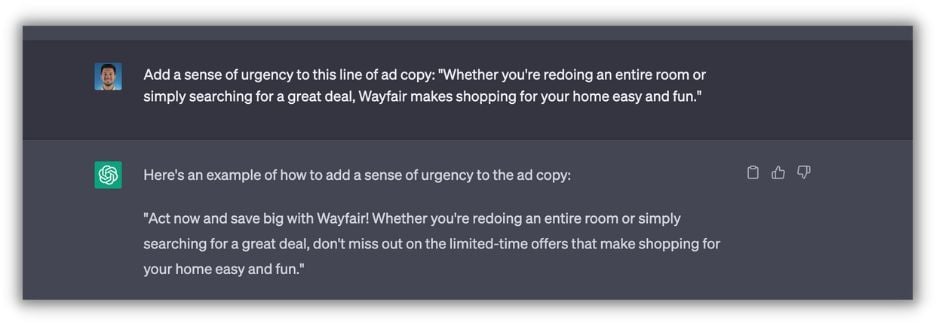
Even the best marketers have periods of writer’s block or feel the copy that they have produced could be better or hit on the desired pain points in a more concise manner. ChatGPT is extremely helpful in these situations as it can also provide additional feedback on your target audience in addition to taking the copy you wrote and editing it to be more readable.
Google is also using AI to help advertisers create and enhance ad copy. They announced asset creation within Performance Max which will use generative AI to generate ad headlines that more closely match search queries.
The bottom line: AI tools like ChatGPT can provide a helpful jumping-off point, but these tools still lack the ability to humanize or infuse personality into ad copy. However, ad copy is such a critical aspect of marketing that any small improvement could have massive returns in regards to CTR and overall ad performance. (Use these ChatGPT prompts as a jumping-off point to help enhance your ad copy.)
Copyright www.wordstream.com